By: Joel Ross
Political campaigns have evolved dramatically over the past two decades. Fundraising went digital. Advertising became data-driven. Outreach went mobile-first. Today’s campaigns track donor conversion funnels, audience engagement, volunteer participation, and first-party data growth with a level of precision that would have seemed extraordinary not long ago.
And at the center of all of it is one core objective: engagement. Not just visibility. Not just awareness — actual, measurable action. Did supporters donate? Did they register? Did they volunteer? Did they show up?
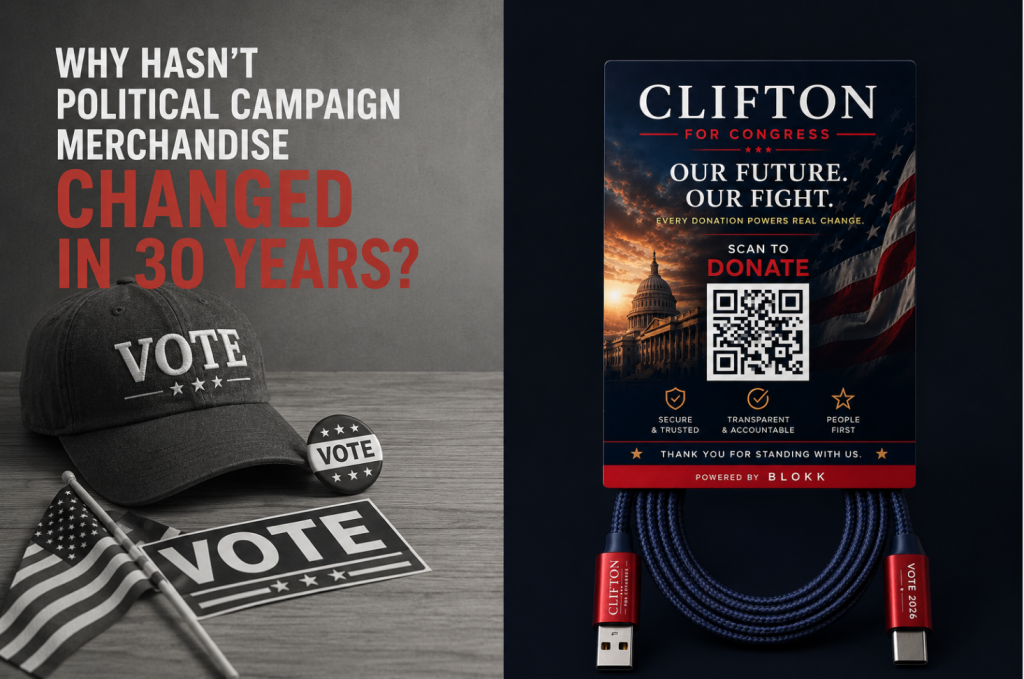
Yet despite all of that evolution, one category has stayed almost completely unchanged: merchandise.
Hats, shirts, yard signs, stickers, buttons — the staples of campaign swag have worked the same way for decades. Put a slogan or a candidate’s name into the world and let repeated exposure do its job. And to be fair, visibility still matters. It always will. But modern campaigns aren’t just competing for impressions anymore. They’re competing for participation in an environment where human attention has become genuinely scarce.
The disconnect no one’s talking about
Here’s the tension: campaigns now spend enormous resources optimizing every corner of their digital outreach — refining fundraising funnels, improving text message engagement, building sophisticated audience systems. And then they hand out a tote bag.
Most traditional merchandise is passive by design. A supporter wears the shirt or slaps the bumper sticker on their car, and the interaction is essentially over. The product might create recognition, but it rarely creates engagement. In a political environment increasingly obsessed with attribution and measurable action, that’s a real problem.
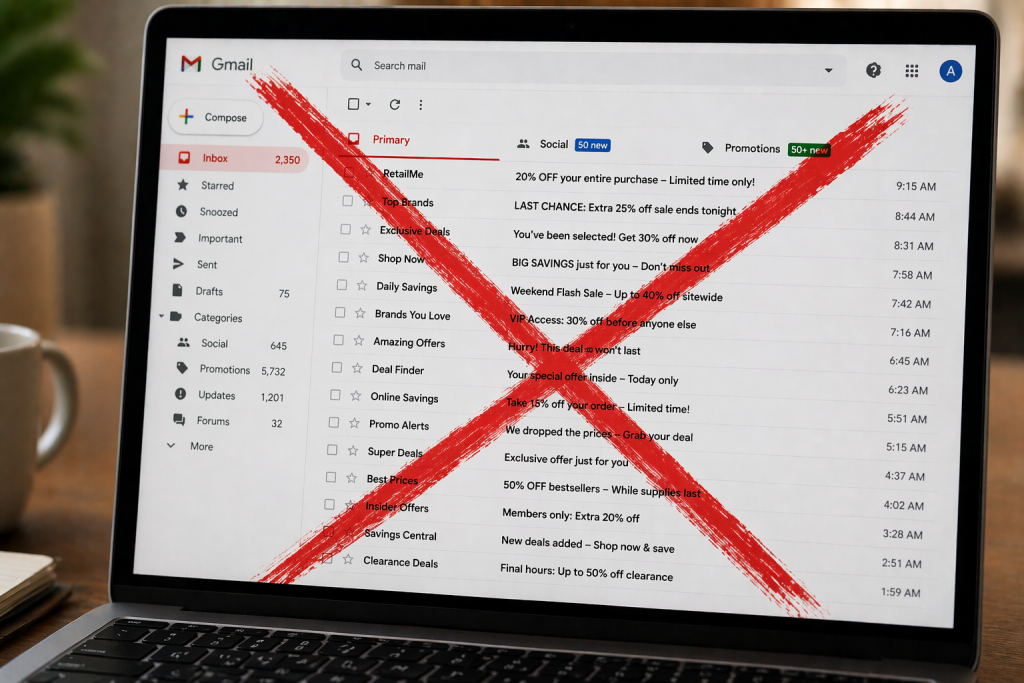
There’s also the broader noise problem. Every election cycle brings more digital ads, more fundraising texts, more emails, more social content — and more competition for the same finite pool of attention. Interruption-based outreach keeps getting more crowded and more expensive, and campaigns aren’t just competing against opposing candidates anymore. They’re competing against the entire digital attention economy.
So how do campaigns create engagement that people actually want?
What utility changes
Most political advertising asks supporters for something — their attention, their time, their clicks, their money. Useful products do something fundamentally different. They provide value first.
Think about a charging cable. It’s not a flashy object, but it solves a real and recurring problem. People rely on their phones for communication, navigation, payments, and just about everything else. Battery anxiety is real. A cable that lives in a backpack, a car, on a desk, or on a nightstand gets used constantly — not because someone was forced to engage with it, but because it’s genuinely helpful.
That distinction matters more than it might seem. Behavioral psychology has studied the principle of reciprocity for decades: when people receive something useful, they tend to develop a stronger emotional connection to the source that provided it. Traditional advertising interrupts. Utility helps. Those are fundamentally different emotional experiences, and they create fundamentally different impressions.
A supporter might barely register a banner ad or a fundraising email. But they’re unlikely to forget something they reach for every single day.
Merchandise as participation infrastructure
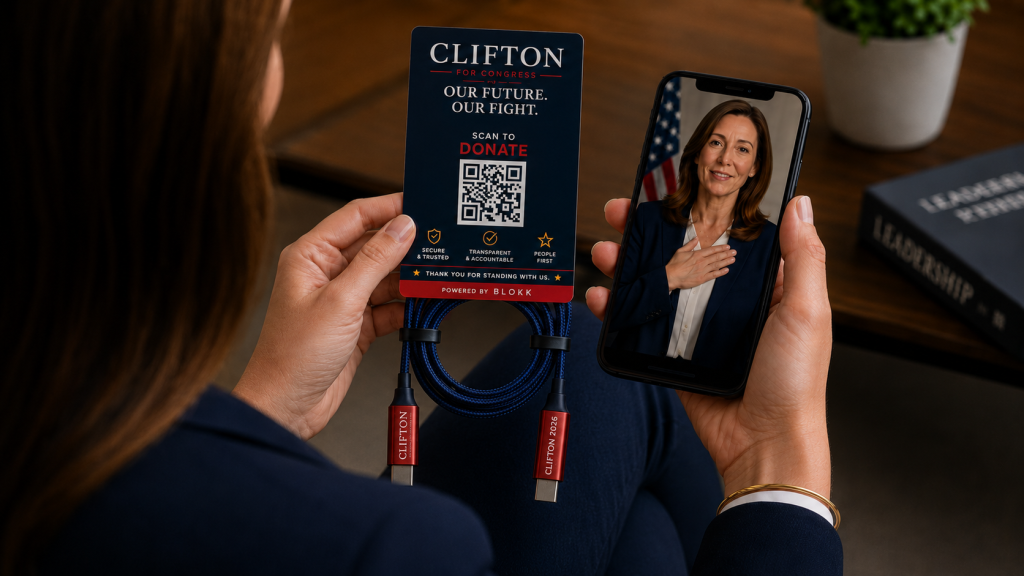
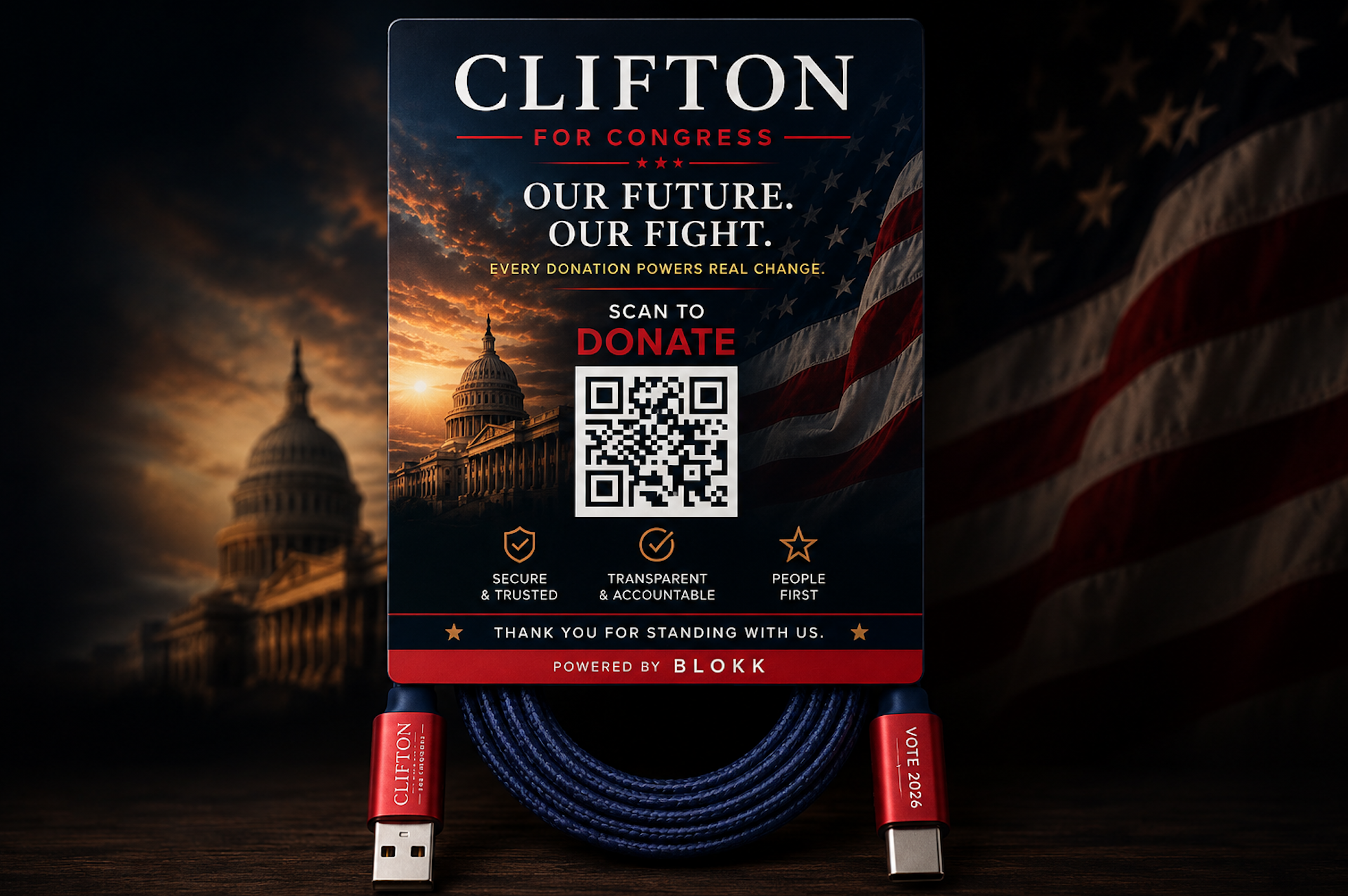
Here’s where the idea gets really interesting. A branded charging cable paired with a Scan-to-Act activation tab doesn’t just sit on a desk — it creates a direct bridge between the physical and digital campaign experience. Supporters can donate, volunteer, register for events, or join an email list directly through the product itself. The merchandise stops being a visibility tool and starts functioning as connected engagement infrastructure.
That changes the equation significantly. Because now the physical object is measurable. It becomes part of the campaign’s digital ecosystem rather than something that exists entirely outside of it.
This matters especially for grassroots fundraising, which is increasingly central to how modern campaigns build momentum. Major donor relationships will always matter, but campaigns that successfully activate large numbers of everyday supporters — and keep them engaged over time — often develop stronger long-term energy than campaigns relying exclusively on top-down donor networks. Utility-based engagement is well-suited to that model precisely because it creates participation organically, through usefulness rather than pressure.
The bigger picture
The smartphone permanently changed campaigning. Supporters now interact with campaigns through mobile donation pages, social media, streaming, texting, and QR-based experiences. Yet most campaign merchandise was never designed with smartphone behavior in mind.
That gap is becoming harder to ignore. Physical campaign materials have historically existed outside a campaign’s digital measurement systems entirely. But they don’t have to anymore — and that’s a meaningful philosophical shift. Campaign merchandise can stop functioning as static promotional material and start functioning as a gateway into measurable digital action.
Campaigns will always need visibility. But in a world saturated with advertising and content, visibility alone is worth less than it used to be. Engagement matters more. Retention matters more. Participation matters more.
And utility might be one of the most underrated ways to get all three. Because when campaign merchandise becomes genuinely useful, something important happens.
It stops being passive. And it starts becoming part of the campaign itself.